IP Camera Engineering for Indoor and Outdoor Use
Silicon Signals Pvt. Ltd. is an Ahmedabad‑based, global R&D and product engineering firm that specializes in end-to-end embedded solutions—spanning hardware, firmware, OS/BSP, device drivers, and system integration. Trusted across industries like automotive, IoT, wearables, healthcare, and avionics, they excel in Linux, Android, QNX, FreeRTOS, Zephyr, Yocto, and more . As a recognized QNX Channel Partner and Toradex service ally, the company delivers scalable, secure, and certified embedded products—from concept through production.
The global IP camera market size was estimated at $16.9 billion in 2025 and is expected to reach $17.9 billion in 2026, mainly due to the rising adoption of AI-based video analytics. (Global Market Insights). Behind every unit shipped sits a different engineering problem depending on where the camera lives. IP camera engineering for a hallway sensor and IP camera engineering for a rooftop unit facing monsoon rain share almost nothing beyond the network protocol. This piece breaks down what separates the two, and what OEMs need to get right before a design reaches production.
The same distinction matters when selecting IP cameras and surveillance systems for indoor, outdoor, industrial, and perimeter applications. The camera’s environment affects the sensor, enclosure, thermal design, lens, and firmware choices from the beginning.
What Is IP Camera Engineering?
IP camera engineering is the discipline of designing network-connected cameras that capture, process, and transmit video reliably across widely different environments and use cases.
Key components of IP camera engineering
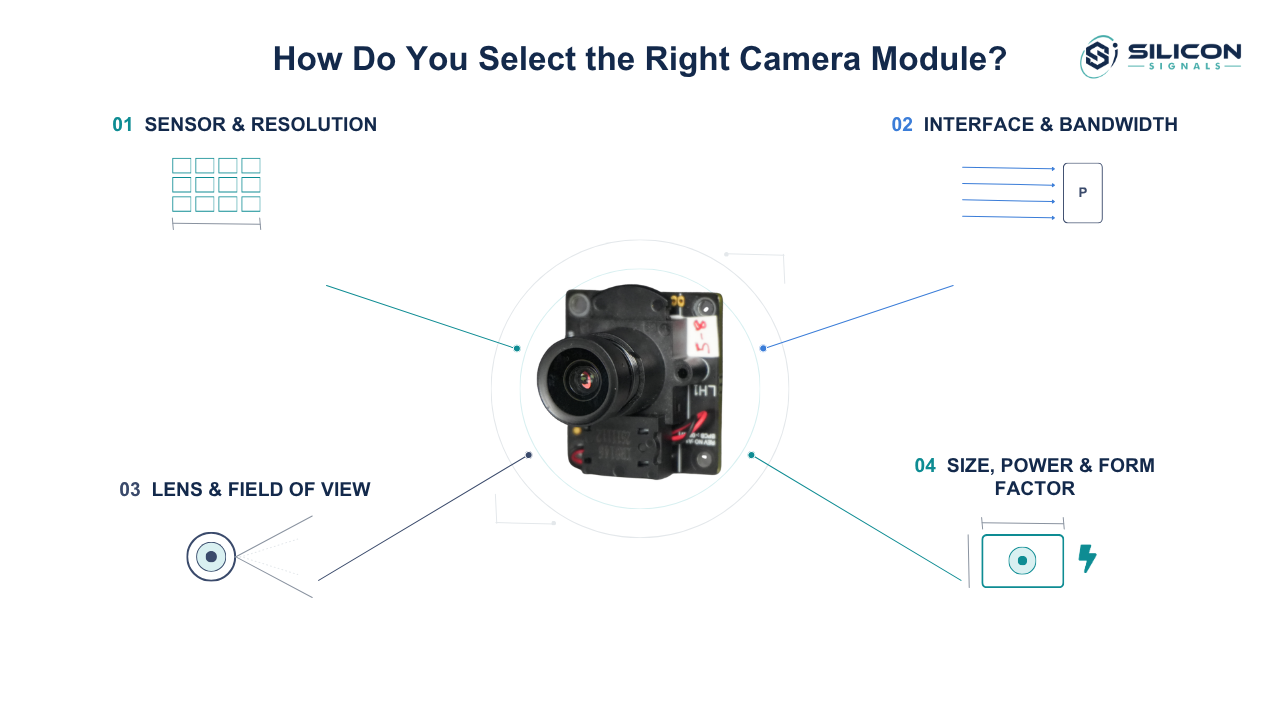
A production camera’s layers are the image sensor, lens and optical path, the image signal processor (ISP), and the system on chip (SoC). The SoC performs image compression, provides the camera’s networking connectivity, and runs the applications on the camera. Good IP camera engineering treats these as one coupled system rather than four separate purchases. A sensor chosen without regard to the ISP's noise reduction algorithm, or a lens paired with the wrong sensor format, creates image artifacts that no amount of firmware tuning can fully correct later.
Hardware and firmware considerations
Hardware sets limits on what a physical camera can be. Firmware determines how well the hardware limitations are compensated for in software. Traditionally, there have been trade-offs between sensor resolution and resolution of encoded video, AI computational power, and IR illumination. Firmware determines the codec used for video compression. More advanced firmware may also incorporate neural network models for edge inference. Like software bugs, thermal throttling and memory leaks can take a long time to become apparent. Because of this, extensive soak testing of firmware should occur early in the development process.
Role of sensor and image processing
The images captured by a sensor are also impacted by the camera's ISP. ISPs can also be tuned to improve image quality for various scenarios. Like with sensors, the trade-offs in camera design become evident in IP camera designs focusing on image quality and analysis.
How Does Indoor IP Camera Engineering Differ?
Design considerations for indoor IP cameras are inherently different from outdoor IP cameras. The more important design considerations for indoor IP cameras is having a small form factor, using components that don’t create a lot of noise, and using components that don’t require active cooling.
Indoor lighting conditions
Indoor environments create a more stable light source than outdoor environments; however, indoor lighting creates a lot of artifacts and fluctuation. Flicker from LCD and LED lighting, mixed color temperature lighting, and reflected surfaces all create challenges for indoor IP camera systems. Indoor IP camera systems must be able to address flicker at 50-60Hz to eliminate image artifacts in a video stream.
Compact camera design
Compact size is one of the most important considerations for indoor IP camera systems. Small size creates challenges for heat dissipation and antenna placement. Because of the small size of the final enclosure, component placement on the PCB is determined early on, and changes to component placement are very costly.
Thermal and power considerations
Small housings for indoor surveillance cameras do not account for variations in temperature; however, they do trap heat. Thermal energy from the SoC and IR LEDs is not properly dissipated. There are several methods to mitigate thermal stress without using a fan. The use of passive heat sinks, creative layout of PCBs and firmware to introduce thermal throttling allows the camera to operate within specified limits. A fan would significantly reduce stress on the components; however, its use would increase cost and introduce unwanted noise to the environment.
Image quality for indoor surveillance
Tuning of Indoor Surveillance Cameras is highly dependent on the intended use case. Features that reduce motion blur and enhance skin tones improve the image and are of more value than a zoom feature. IR Cut Filters are used to remove IR illumination to capture ambient light. This filter is removed during the IR mode to improve image capture.
What Makes an Outdoor IP Camera Reliable?
Outdoor security cameras are exposed to numerous different conditions based on where they are deployed. They need to perform well under all of these conditions in order to capture a clear image. These conditions include but are not limited to, daytime and nighttime.
Weather and environmental protection
All outdoor security cameras must have an ingress protection rating of at least IP66 to be protected from the elements. The biggest cause of field failures is seal failures around the lens and other cable entries. Other field failures occur due to the material used in the seal and the torque used during assembly.
Temperature and humidity management
Security cameras can be exposed to wide temperature variations from -30°C to 60°C. This can result in condensation. Prolonged exposure to moisture can cause corrosion to electrical contacts. Sealing the case can protect the circuit board. A desiccant can also be placed in the case to absorb moisture.
Outdoor lighting and exposure challenges
Outdoor conditions are the ultimate test of a camera sensor and ISP. Huge differences in lighting in the same scene (aka high-dynamic scene) are common outdoors. An IP camera can’t always control how much of the sky is in a given scene, and they need to be able to capture full scenes that include deep shadows.
For a closer look at glare, low-light scenes, mixed lighting, and changing exposure, see ISP tuning for IP cameras in challenging lighting.
Housing and mechanical design
Cursor, moisture, and other environmental factors can affect the materials used in a camera housing. Outdoor cameras intended for public and perimeter surveillance need to protect against the elements and be impact-resistant and vandal-proof. These require the use of metal brackets and housings with Polycarbonate facings that are stabilized for UV. Also, the housings can include an impact-resistant dome.
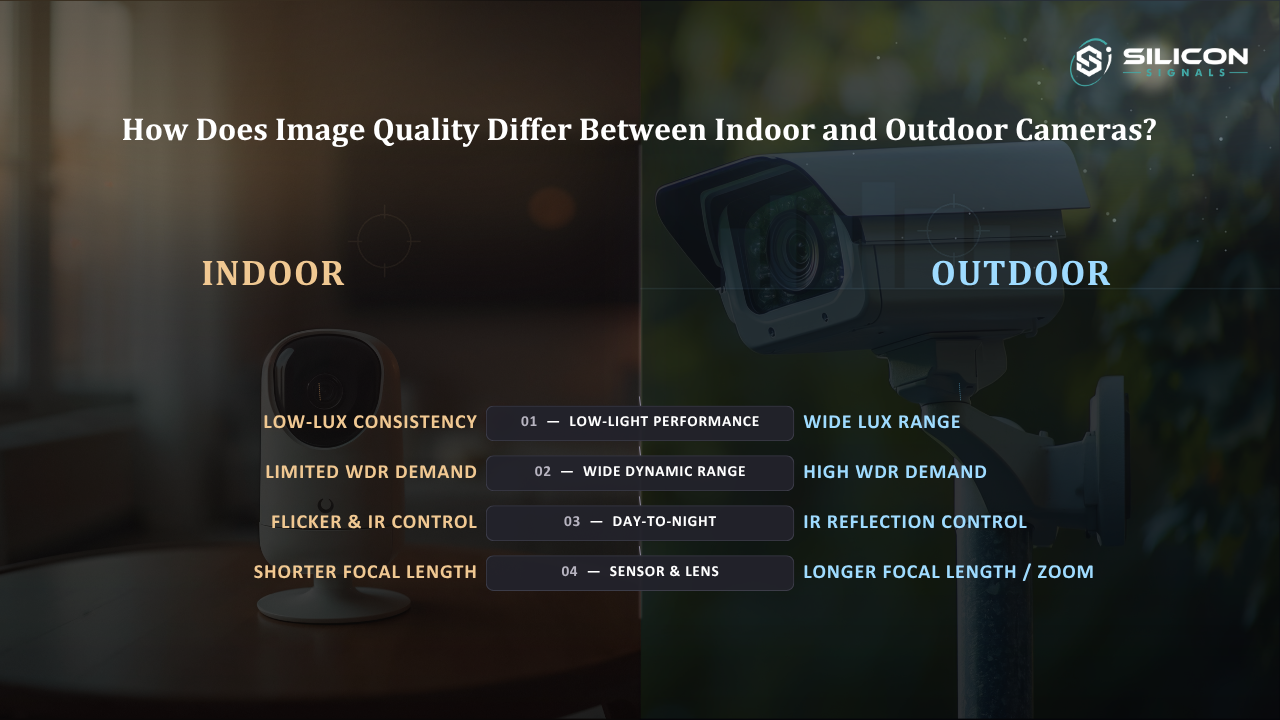
How Does Image Quality Differ Between Indoor and Outdoor Cameras?
Image quality priorities change depending on whether the scene is indoors or outdoors. For scenes that are mostly indoors, camera priorities are reducing flicker and other artifacts. For scenes that are mostly outdoors, the priorities are control of the exposure and dynamic range of the captured scene.
Low-light performance
Because indoor scenes usually have a lower limit to the amount of available light, a surveillance camera can be tuned to operate at a relatively lower lux level. On the other hand, an outdoor IP camera has to operate at a wide range of lux levels, e.g., from a very bright scene to a very dark scene. Operating at a wide range of lux levels can be achieved by using a larger sensor, a wide-aperture lens, or using a starlight sensor.
Wide Dynamic Range (WDR)
An IP camera is more likely to be exposed to situations where Wide Dynamic Range (WDR) is required outdoors, rather than indoors. For situations where WDR is required, having a large sensor and using a lens with a wide aperture helps. Using multiple sensors and taking multiple pictures of the same scene and fusing them can give better results than post-processing digital WDR.
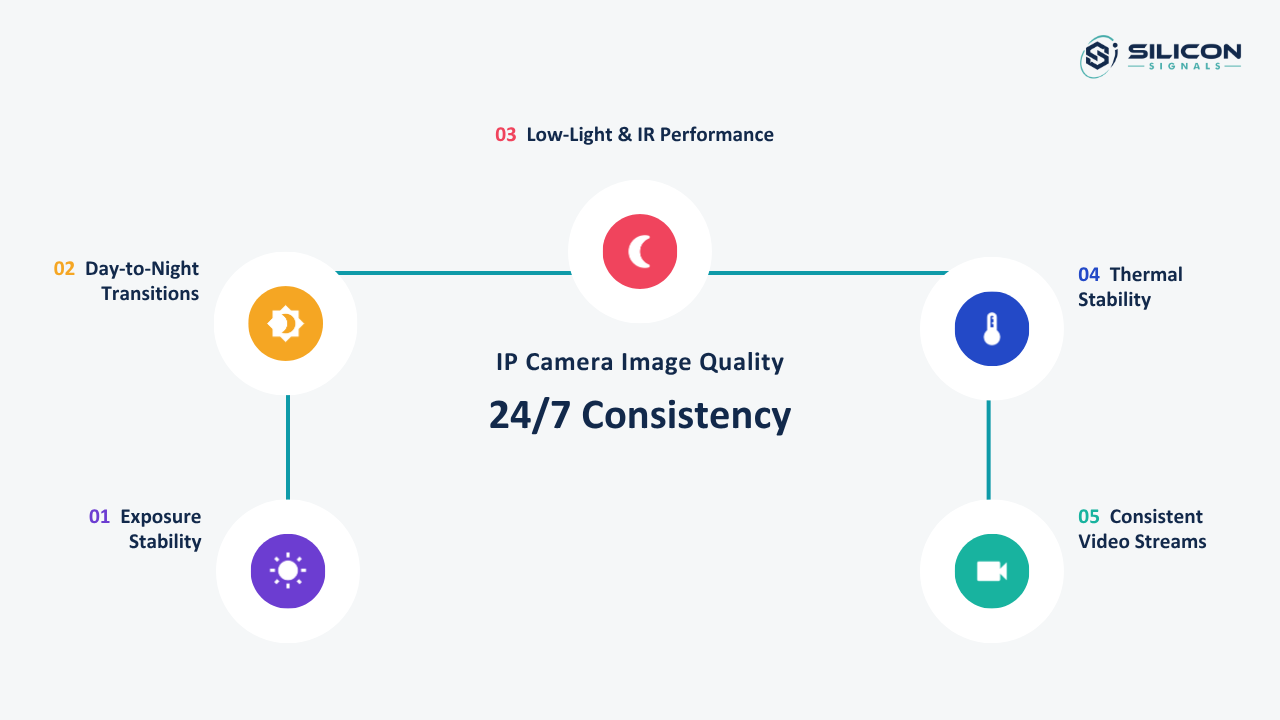
Day-to-night image consistency
Indoor and outdoor units both make use of an IR cut filter to be able to see in the dark. Outdoor units, however, also need to contend with IR reflection from wet surfaces.
Sensor and lens selection
Because most of the subjects of interest in a typical indoor surveillance situation are relatively near to one another, smaller sensors and shorter fixed focal length lenses can be used. Longer focal length lenses and mechanical zooms are used in outdoor surveillance to capture subjects of interest that may be relatively far-away.
What Should OEMs Consider When Engineering IP Cameras?
OEMs need to balance deployment environment, connectivity, security, and long-term serviceability before committing to a hardware platform.
Camera form factor and deployment environment
The decision between a compact indoor surveillance camera and a ruggedized outdoor IP camera should come from the target deployment, not from reusing an existing design out of convenience. Mismatched form factors are a common source of returns and warranty claims.
Network and connectivity requirements
There are several factors to consider when planning bandwidth, such as frame rates and resolutions, as well as codec efficiencies and the number of devices on a shared network. Designs using wired PoE are always assumed to be reliable, with design tradeoffs for utilizing wireless communication (e.g. cellular and Wi-Fi) factored into the enclosure design.
Firmware and cybersecurity
Camera fleets are favorable attack surfaces. It’s no longer a case of “should we?” or “can we?” when implementing defensive features. Instead, it has become a case of “how quickly can we?” implement them. Integrators and end users have hard deadlines for integrating defensive features into their products.
Long-term reliability and maintenance
A camera that ships clean but degrades after eighteen months in the field creates support costs that outweigh the original margin. Component derating, connector selection, and firmware update mechanisms all need to be planned with a five to seven-year service life in mind.
How Can OEMs Develop Production-Ready IP Cameras?
Moving from prototype to shippable product requires disciplined integration, tuning, and validation across hardware and firmware together. This is where camera design engineering helps connect sensor selection, PCB design, firmware, thermal management, ISP tuning, and production testing.
Hardware and sensor integration
Sensor datasheets rarely tell the full story. Real integration work involves validating signal integrity between the sensor and SoC, confirming power sequencing, and checking EMI behavior on the actual board layout rather than a reference design.
BSP and firmware development
A board support package tailored to the target SoC, camera driver stack, and encoder pipeline determines how much of the sensor's raw capability actually reaches the end user. Custom BSP work is where many camera programs lose the most schedule time if it is underestimated at the planning stage.
ISP tuning and image validation
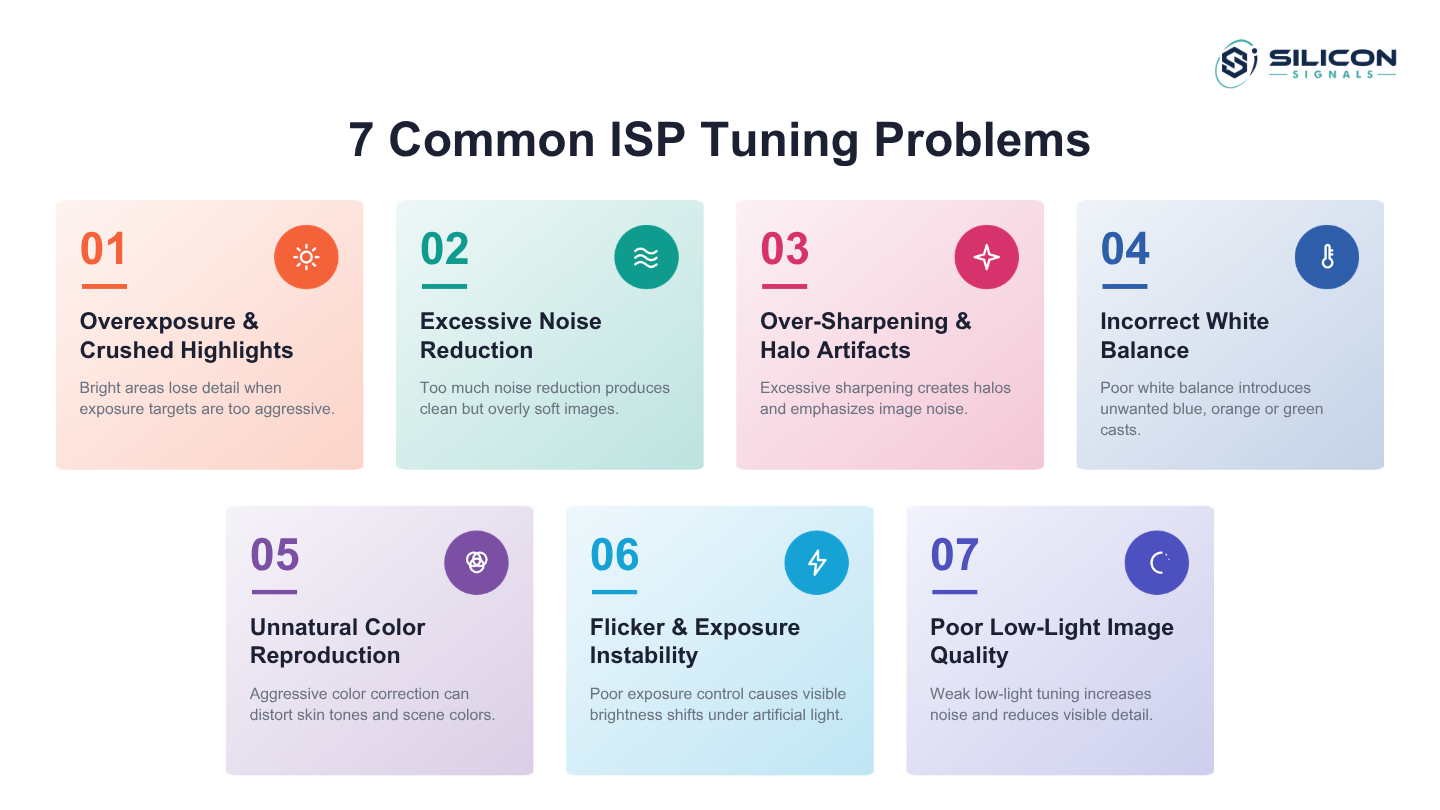
ISP tuning is done on an iteration basis and is case by case. For a unit to be considered tuned, test labs have to be equipped with controlled lighting and outdoor test sites. A unit is also evaluated based on exposure, color accuracy, noise, and WDR. It is of utmost importance to evaluate a camera unit under these conditions to avoid surprising and frustrating end users.
Testing for real-world deployment conditions
The last phase of assessment and validation for a device may include subjecting the device to extended tests such as temperature cycles and exposure to humidity, as well as tests to evaluate shock, vibration, and other types of wear load, and to assess the stability and availability of a communication/network in the field for a prolonged period of time.
Conclusion
Indoor and outdoor IP camera engineering demand different tradeoffs in optics, thermal design, and image tuning, but both rest on the same disciplined hardware and firmware integration process. OEMs that treat these as distinct engineering problems, not variations of one template, ship more reliable products. Silicon Signals works with OEMs on exactly this kind of camera development, from sensor selection through ISP tuning and field validation, for both indoor and outdoor deployments.