How to Validate ISP Tuning Before Camera Production
Silicon Signals Pvt. Ltd. is an Ahmedabad‑based, global R&D and product engineering firm that specializes in end-to-end embedded solutions—spanning hardware, firmware, OS/BSP, device drivers, and system integration. Trusted across industries like automotive, IoT, wearables, healthcare, and avionics, they excel in Linux, Android, QNX, FreeRTOS, Zephyr, Yocto, and more . As a recognized QNX Channel Partner and Toradex service ally, the company delivers scalable, secure, and certified embedded products—from concept through production.
A camera that looks perfect in lab tests can fail in deployment due to lighting issues, motion artifacts, and variations between different sensors. As described in the Dataintelo report, the global embedded vision systems market size reached $12.8 billion in 2025 and is expected to reach $32.5 billion by 2033, growing at a compound annual growth rate of 12.3%. Embedded vision cameras ship in larger volumes into automotive vehicles, manufacturing machines, and clinical devices. Productivity and safety depend on correct ISP processing.
What Is ISP Tuning Validation?
ISP tuning validation is the structured testing process that confirms an image signal processor’s configuration meets defined image quality targets across lighting conditions, scenes, and hardware variation. It sits between initial tuning and production sign-off.
ISP Tuning vs. ISP Tuning Validation
ISP tuning is the creative and technical work of adjusting parameters such as exposure curves, white balance algorithms, noise reduction strength, and sharpening filters to produce a target image look. ISP validation is the verification layer that checks whether those settings behave consistently once the camera leaves the lab bench.
A tuning engineer optimizes for a specific test chart or scene. A validation engineer stresses that same configuration against dozens of lighting scenarios, sensor samples, and motion conditions to find where it breaks. Camera image validation helps separate a demo-ready prototype from a shippable product.
Why ISP Validation Should Happen Before Production
When a camera module enters mass production, the ISP is essentially hardcoded in the firmware that will be shipped in thousands or even millions of modules. An exposure problem, color offset, or noise artifact not discovered during testing becomes a field defect, which will cost much more to correct than a firmware patch or a hardware recall. ISP validation before production catches these problems while changes are still cheap: a parameter adjustment in tuning software versus a firmware patch pushed to deployed devices.
What Camera Image Quality Parameters Need Validation?
A full validation process entails evaluating the camera’s exposure accuracy, white balance, color rendering, noise levels in relation to ISO speeds, image sharpness without artificial sharpening effects, dynamic range handling in high-contrast situations, and autofocus performance. Each parameter interacts with the others, so validation has to test combinations, not isolated settings.
When Should You Validate ISP Tuning in the Camera Development Cycle?
ISP validation is not a single milestone. It runs in stages that align with hardware maturity, starting early with sensor selection and continuing through the final production build.
Sensor and Lens Evaluation
Before performing tuning, a characterization process for the lens–sensor combination has to be done. In this phase, the noise floor of the raw sensor, lens distortion, vignetting, and dynamic range will be measured. The limitations identified here define the actual compensation that can be made by the ISP in later processes.
Initial ISP Tuning and Image Bring-Up
After hardware becomes available, engineers initialize the ISP pipeline and begin the first tuning pass for exposure, colors, and noise. At this stage, an image is achieved, but the process is still not validated. It establishes the starting point that later validation cycles will stress test.
Pre-Production Image Validation
With the design more stable, validation during the pre-production phase tests the camera across a range of scenarios that include different lighting environments, dynamic movement, and edge cases such as backlighting and low-light situations. This is when ISP tuning services carry out their tests based on an image quality specification to see how well the sensor performs.
Final Validation Before Mass Production
The final validation will take place on production-equivalent hardware, with the actual sensor sample, the lens assembly, and the firmware release that will be used in the manufacturing process. Any tuning performed during this phase requires full revalidation because of the unexpected effects of even small changes in the ISP parameters.
What Does a Camera Image Validation Process Check?
Validation of camera image quality involves verification of quality metrics that can be measured objectively through analysis of images, rather than relying on subjective assessment of a single test image.
Exposure and Brightness Consistency
In this step, the ISP validates the ability of the auto-exposure algorithm to reach appropriate levels of brightness promptly and sustain them consistently when the scene is changing.
White Balance and Color Accuracy
The color validation process verifies whether the white balance mechanism is able to compensate for different lighting sources and adapt appropriately to avoid unwanted color casts and to preserve natural skin tones.
Noise Reduction and Low-Light Performance
At this stage, the ISP measures noise reduction at all ISO or gain settings and the consistency of noise suppression with no loss of detail and no degradation to a plastic-like picture.
Sharpness, Detail, and Texture Preservation
The sharpening validation process analyzes edge contrast, the level of detail and texture, and checks for over-sharpening effects like halos on high-contrast edges and fake textures.
HDR and Dynamic Range Performance
The high dynamic range test validates the performance of the system in maintaining detail in highlights and shadows in the same image, which is a common flaw in backlit or indoor–outdoor scenarios.
Auto-Focus and Image Stability
The validation test for a camera with an auto-focus feature determines the speed, precision, and how the focus algorithms perform when presented with low-contrast or low-light scenarios.
Day-to-Night and Difficult Lighting Transitions
Validation of this scenario determines the performance of the ISP in terms of shifting settings for exposure, color, and noise with gradual changes in lighting conditions, instead of abrupt shifts.
How to Validate ISP Tuning Before Camera Production
A structured ISP validation workflow moves from defined requirements through controlled testing to a frozen, documented configuration ready for manufacturing.
Define Image Quality Requirements
Before conducting tests, the team needs tangible image quality goals for the device that are directly related to the use case of the product and not arbitrary benchmarks taken from an unrelated application.
Establish Controlled Testing Conditions
For repeatable results, controlled lighting rigs, calibrated light sources, and test charts are needed so that variations in the image are due to the ISP, not variability in the test itself.
Capture Reference Images Across Lighting Conditions
Engineers acquire reference images in various lighting environments, including bright outdoor light, dark indoor light, backlighting, and low-light conditions.
Compare Tuned Images Against Target Image Quality
Each captured image is compared against the defined quality targets using both objective measurements and visual inspection, flagging any parameter that falls outside the acceptable range.
Test Auto-ISP Behavior Across Scenes
Static test charts do not tell the whole story. Validation also includes an evaluation of the behavior of the auto-exposure, auto-white balance, and auto-focus algorithms as the scene changes.
Measure Image Quality and Identify Artifacts
This step uses quantitative image quality metrics alongside trained visual review to catch artifacts that numbers alone might miss, such as color banding or motion smear.
Validate Performance on Production Hardware
Tuning done in the lab using evaluation boards should be revalidated using the actual camera module because differences in PCB design, power supply, and lens mounting can affect the outcome.
Document and Freeze the Final ISP Configuration
Once the configuration passes every validation stage, it is documented and locked as the production baseline, with version control so future firmware updates can be tested against a known reference.
Which Lighting Conditions Should Be Included in ISP Validation?
Lighting accounts for the largest part of camera image verification since it affects exposure, color temperature, and noise at once.
Bright Outdoor Scenes
Direct sunlight tests highlight retention, color accuracy under high illuminance, and whether the sensor’s dynamic range holds detail in bright surfaces without clipping.
Indoor and Mixed Lighting
Indoor scenes combine multiple light sources with different color temperatures, testing whether white balance algorithms can isolate a correct reference point instead of averaging into an inaccurate result.
Low-Light and Night Scenes
Nighttime and low-light scenarios put the ISP’s ability to reduce noise and manage exposure to the test, thereby showing whether the tuning services provided throughout development have merit when the signal-to-noise ratio becomes low.
Backlit and High-Dynamic-Range Scenes
A backlit scenario is a case where the subject is placed in front of a bright window, thus testing whether the ISP is able to balance exposures in both the foreground and background.
Moving Subjects and Changing Illumination
Motion brings additional failure mechanisms to the table, namely exposure lag, motion blur, and rolling shutter effects, each of which must be tested under constant and changing light conditions.
How Do You Measure ISP Tuning Performance?
Measuring ISP tuning performance combines quantitative image quality metrics with structured human review, since neither approach alone captures the full picture.
Objective Image Quality Measurements
The objective image quality test uses quantifiable metrics like signal-to-noise ratio, dynamic range, color accuracy error, and modulation transfer function to measure sharpness and detail preservation.
Subjective Image Quality Evaluation
Professional evaluators examine the images for characteristics that are difficult to quantify, such as the natural look of an image, correct skin tones, or whether noise reduction has given an unnatural look.
Reference Scene and Image Comparison
The comparison of the tuned image against a reference image, obtained using a calibrated reference camera in the same lighting conditions, provides a consistent basis for evaluating the changes made through tuning.
Artifact Detection and Consistency Testing
Here we look for artifacts such as color banding, flicker, ghosting, or inconsistencies in the behavior of cameras from the same model, because proper average behavior may hide inconsistency between units.
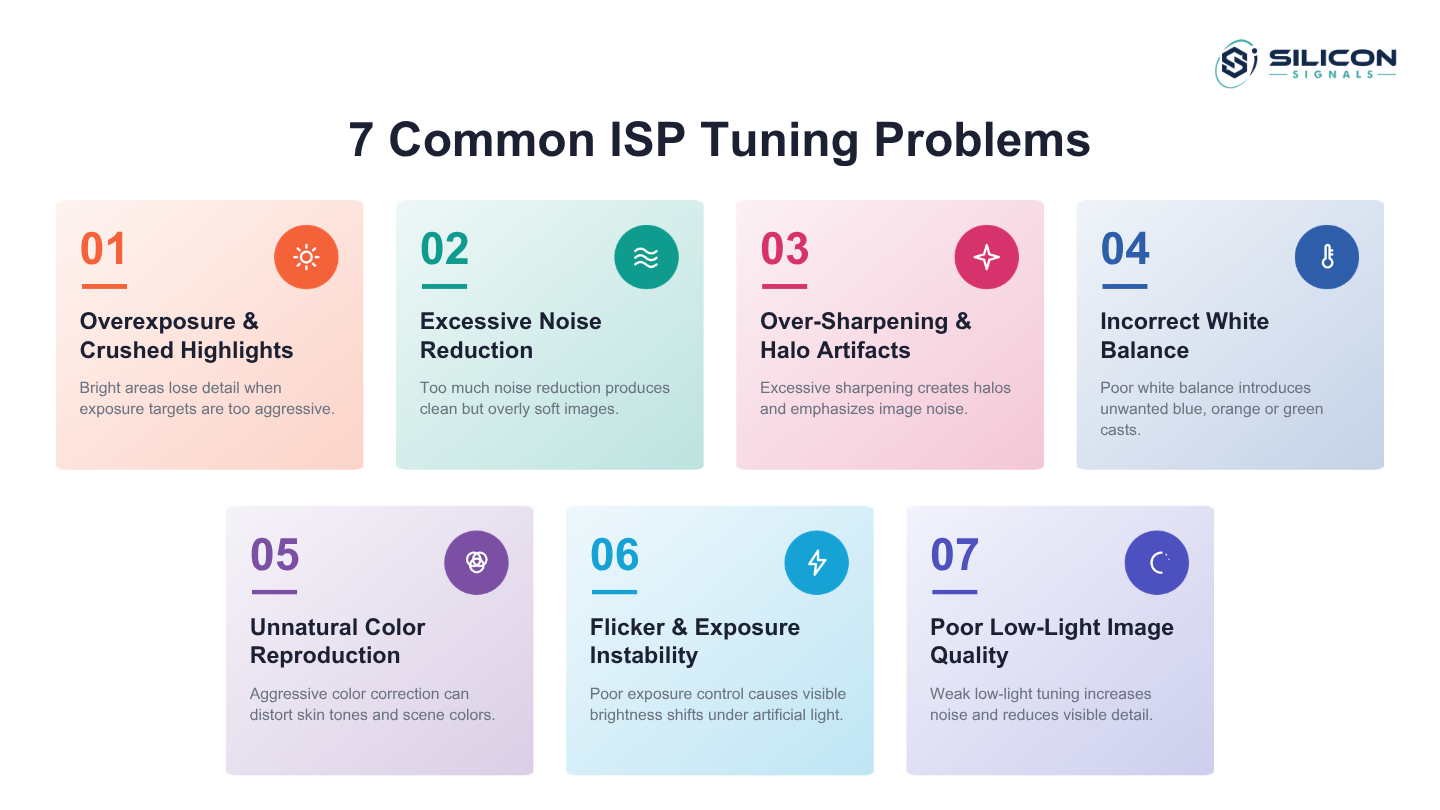
7 Common ISP Tuning Problems Found During Camera Validation
Most ISP tuning issues fall into a recognizable set of patterns, and catching them during validation is far cheaper than catching them after launch.
Overexposure and Crushed Highlights
Aggressive exposure targets will cause bright portions of a photo to burn out, with no detail that can be retrieved through post-processing.
Excessive Noise Reduction
When too much noise reduction is applied, the result is clean images without grain but also lacking in detail.
Over-Sharpening and Halo Artifacts
When an image is over-sharpened, halos form on the edges, and the visibility of any noise increases.
Incorrect White Balance
A poorly tuned white balance algorithm can cast entire scenes in a blue or orange tint, especially under mixed or unusual lighting sources.
Unnatural Color Reproduction
Oversaturated or shifted color reproduction, particularly in skin tones and greenery, is a frequent finding during camera image validation and often traces back to overly aggressive color correction matrices. For more on how this affects image quality, see color correction in camera ISP.
Flicker and Exposure Instability
An over-sensitive auto-exposure system that reacts quickly to slight variations in lighting will result in visible flickering or brightness fluctuations, especially when operating in conditions where different light sources have different refresh rates.
Poor Low-Light Image Quality
Low-light performance is one of the last factors to be optimized and validated.
Conclusion
Structured ISP validation protects image quality, timelines, and production budgets before a design ever reaches mass manufacturing. Final validation typically occurs as part of a broader camera design engineering workflow that connects hardware, firmware, ISP tuning, and production qualification.
The steps for defining requirements, controlling tests, and freezing configurations align with best practices described in how to choose an ISP tuning service provider.
Silicon Signals works with hardware teams as a camera design company specializing in camera development, helping validate ISP tuning against real-world conditions before production freeze.