How Camera Modules Accelerate Robotics Development
Silicon Signals Pvt. Ltd. is an Ahmedabad‑based, global R&D and product engineering firm that specializes in end-to-end embedded solutions—spanning hardware, firmware, OS/BSP, device drivers, and system integration. Trusted across industries like automotive, IoT, wearables, healthcare, and avionics, they excel in Linux, Android, QNX, FreeRTOS, Zephyr, Yocto, and more . As a recognized QNX Channel Partner and Toradex service ally, the company delivers scalable, secure, and certified embedded products—from concept through production.
The robotic vision sensor market is projected to grow from 2.89 billion dollars in 2025 to 3.27 billion dollars in 2026, expanding at roughly 13% annually according to Research and Markets. Behind that number is a practical reality for engineering teams: a robot without reliable vision cannot operate safely outside a fixed, pre-mapped environment. A robotics camera module is what gives a machine the ability to see, and the choice of module has a direct effect on how quickly a robotics program moves from prototype to deployment.
Why Vision Is Critical to Modern Robotics
Robots that rely on fixed rails, hard-coded paths, or simple proximity sensors cannot adapt to change. Vision gives a robot the ability to react to a world that is not perfectly controlled, which is why camera modules have become a core subsystem rather than an optional add-on.
How Robots Use Cameras to Understand Their Environment
A robotics camera module captures continuous frames that feed into perception software, allowing the robot to identify objects, measure distances, and detect obstacles that were never part of its original programming. This turns a robot from a device that repeats fixed motions into one that responds to what is actually in front of it.
The Role of Embedded Vision in Autonomous Systems
Embedded vision moves the interpretation of camera data onto the robot itself instead of a remote server. For an autonomous mobile robot navigating a warehouse floor, that local processing is what makes real-time obstacle avoidance possible, since a network delay of even a few hundred milliseconds can be the difference between stopping in time and a collision.
From Basic Imaging to AI-Powered Machine Vision
Early robotic vision used simple edge detection and color thresholds to find objects. Modern systems pair a robotics camera module with trained neural networks capable of recognizing thousands of object classes, adapting to lighting changes, and estimating pose, which has expanded what robots can be trusted to do without human oversight. The shift also changed how engineering teams think about the camera itself. A module is no longer selected purely on resolution or price. It is selected on how consistently it delivers frames a model can interpret across the full range of conditions the robot will actually encounter, from a dim loading dock to a sunlit warehouse dock door.
What Is a Robotics Camera Module?
A robotics camera module is a compact imaging unit designed specifically for integration into a robot's control system, built to survive vibration, variable lighting, and continuous operation while feeding usable data to onboard compute.
Core Components of a Robotics Camera Module
The module combines an image sensor, a lens matched to the robot's operating distance and field of view, and an interface that connects to the robot's compute board. Supporting firmware manages exposure and synchronization, which matters when a robot has multiple cameras that need to capture frames at the same instant for accurate depth calculation.
Image Sensors, Lenses, and Processing
Sensor choice determines how well the robotics camera module performs in the robot's actual operating conditions, whether that means a warehouse with inconsistent lighting or an outdoor environment with direct sunlight. The lens has to match both the sensor format and the physical mounting constraints of the robot chassis, and processing has to keep pace with the robot's movement speed to avoid motion blur degrading detection accuracy.
Interfaces Such as MIPI CSI-2 and USB
Most robotics camera module designs use MIPI CSI-2 for direct, low-power connections to an embedded processor, while USB remains common in prototyping or in systems where the camera needs to connect to a general-purpose compute module. The interface choice affects latency, cable length limitations, and how many cameras a single processor can support simultaneously. A robot with multiple cameras for stereo depth or 360-degree coverage needs an interface architecture that can handle several simultaneous streams without overloading the processor's available bandwidth, which is a constraint that becomes obvious only once a design moves past a single-camera prototype.
How Camera Modules Speed Up Robotics Development
Choosing the right robotics camera module early in a program removes several categories of engineering risk that otherwise surface late, when they are far more expensive to fix.
Reduce Hardware Development Time
Starting from a proven camera module instead of designing a sensor board from scratch removes months of layout, signal integrity, and driver bring-up work, letting the engineering team focus on the robot's actual perception and control logic.
Simplify Embedded Vision Integration
A module built with embedded vision integration in mind ships with drivers and reference designs that already work with common robotics compute platforms, cutting down the trial and error normally required to get a new sensor talking to a processor.
Accelerate AI Vision Deployment
Pre-validated modules reduce the number of unknowns between raw sensor data and a working AI vision pipeline, allowing perception teams to focus on model training and tuning rather than debugging inconsistent frame delivery.
Minimize Testing and Prototyping Challenges
A robotics camera module that has already been validated for vibration, temperature range, and continuous duty cycles saves a robotics team from discovering hardware failures during field testing, when a redesign is far more disruptive than during the component selection phase. Continuous duty cycles matter more in robotics than in most other embedded vision applications, since a warehouse robot may run its camera for sixteen or more hours a day, every day, for years. A module that was only characterized for short bursts of use is a common source of unexpected field failures once a robot moves from a demo environment into daily operation.
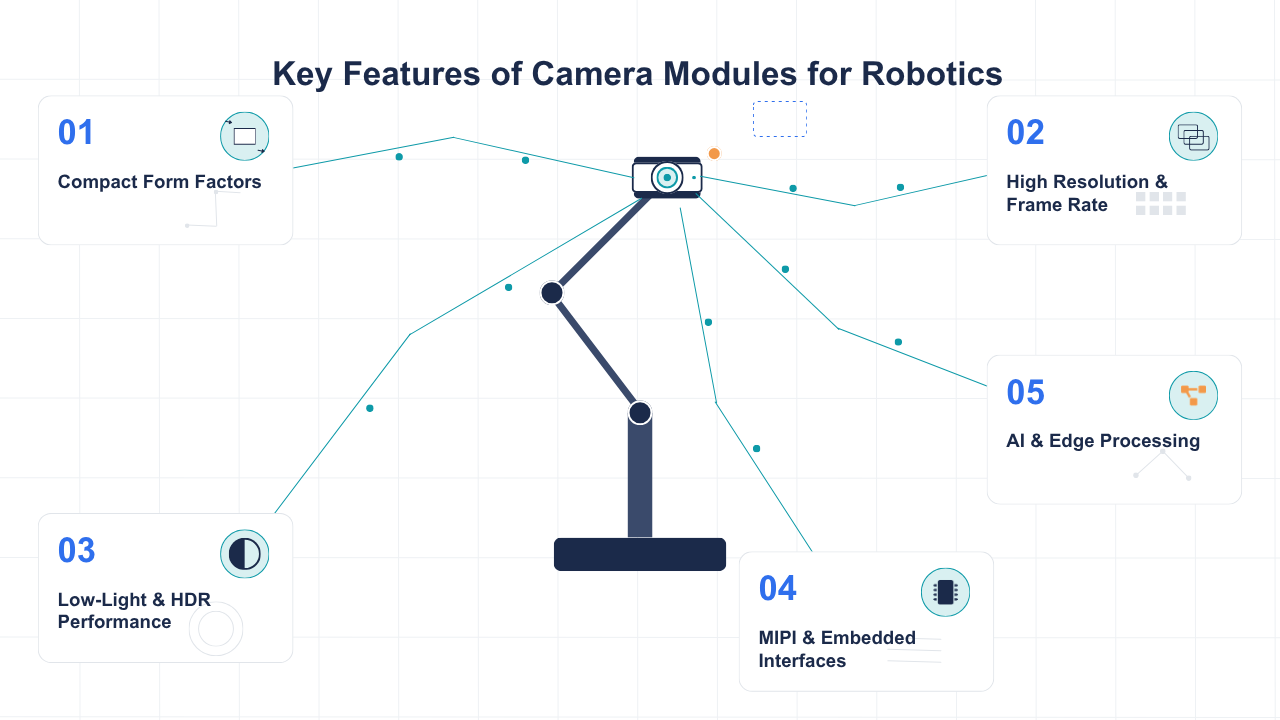
Key Features of Camera Modules for Robotics
The requirements for a robotics camera module differ from those of a consumer camera in ways that directly affect reliability in the field.
Compact Form Factors for Space-Constrained Designs
Robots, especially mobile and articulated ones, have limited internal volume, so a robotics camera module needs a small footprint that still leaves room for the lens assembly and any required heat dissipation.
High-Resolution and High-Frame-Rate Imaging
Higher resolution supports fine-grained object recognition, while a higher frame rate reduces motion blur for robots moving at speed or manipulating fast-moving parts on a production line.
Low-Light and HDR Performance
Warehouses, outdoor environments, and industrial facilities rarely offer consistent lighting, and a robotics camera module with strong low-light and high dynamic range performance keeps perception accurate across those variable conditions.
MIPI and Other Embedded Interfaces
A well-designed interface layer, typically MIPI CSI-2, keeps data transfer low-latency and low-power, which matters for battery-powered mobile robots where every milliwatt affects operating time.
AI and Edge Processing Capabilities
Some robotics camera module designs include onboard processing that runs a portion of the inference pipeline directly on the camera, reducing the load on the robot's main compute board and freeing it for higher-level planning and control. These camera-side AI cameras are particularly useful in robots carrying several sensors at once, where a single central processor would otherwise become a bottleneck for every vision stream running through it.
Applications of Robotics Camera Modules
Vision requirements shift significantly depending on what the robot is built to do, which is why module selection has to start with the specific use case.
Autonomous Mobile Robots
These robots depend on a robotics camera module for real-time mapping, obstacle avoidance, and path planning as they move through dynamic environments shared with people and other equipment.
Industrial Robotic Arms
Robotic arms use vision for precise part location and orientation detection, often requiring a global shutter camera module to avoid the distortion that a rolling shutter would introduce during fast arm movement.
Warehouse and Logistics Robots
Sorting, picking, and inventory robots rely on embedded vision to identify packages, read labels, and navigate aisles without requiring the facility to be re-mapped every time inventory shifts.
Inspection and Quality-Control Robots
Robots performing automated inspection need high-resolution imaging paired with consistent lighting compensation to catch defects reliably at production line speed.
Service and Delivery Robots
Robots operating around people, such as delivery or service robots, need robust obstacle detection and human recognition, placing a premium on low-light performance and dependable AI vision under unpredictable conditions. These robots often operate across sidewalks, lobbies, and mixed indoor-outdoor routes in a single trip, which means the robotics camera module has to hold up across far more lighting transitions than an industrial camera confined to a single factory floor ever encounters.
How AI Cameras Enhance Robotic Vision
AI cameras extend what a robotics camera module can do by adding interpretation directly into the imaging pipeline rather than treating vision as a passive data feed. As robots take on more autonomous decision-making, the line between the camera and the AI system that interprets its output keeps narrowing, and AI cameras are increasingly where that line disappears entirely.
Real-Time Object Detection
AI cameras run trained models against incoming frames to identify objects as they appear, giving the robot the ability to react to unplanned obstacles or new items without operator intervention. In a warehouse setting, this means a robot can flag a fallen box or a person stepping into its path within the same frame cycle it would have used to simply record the scene, rather than waiting for a separate detection pass.
Object Tracking and Recognition
Beyond single-frame detection, AI cameras track objects across frames, maintaining identity even as objects move, which supports tasks like following a specific item through a sorting line or monitoring a person's position relative to the robot. This capability is what separates a simple detection system from one a robot can actually plan around, since knowing where an object was a moment ago is often as important as knowing where it is right now.
Depth and Spatial Understanding
Stereo and depth-sensing configurations give a robot spatial awareness beyond a flat image, allowing it to judge distance and avoid collisions in three-dimensional space rather than relying on 2D approximations.
Edge AI for Faster Decision-Making
Running inference at the edge, close to the robotics camera module itself, cuts the time between a frame being captured and a decision being acted on, which is essential for any robot operating near people or fast-moving machinery. Edge AI also keeps the robot functional when network connectivity is inconsistent, which is common in large warehouses, outdoor sites, and underground facilities where a cloud-dependent vision pipeline would leave the robot blind at exactly the moments reliability matters most.
Choosing the Right Robotics Camera Module
Selecting a module requires weighing the robot's operating environment, compute platform, and long-term support needs together rather than optimizing for a single specification.
Match Resolution and Frame Rate to the Application
A slow-moving inspection robot has different requirements than a fast mobile robot navigating a busy warehouse, and matching resolution and frame rate to the actual task avoids overspending on capability the application does not need.
Consider Interface and Processor Compatibility
Confirm that the robot's compute platform supports the chosen interface, whether MIPI CSI-2 or USB, and that driver support exists for the target operating system before committing to a specific robotics camera module.
Evaluate Size, Power, and Thermal Requirements
Mobile and battery-powered robots need modules that fit their power budget without generating heat that the chassis cannot dissipate, which often narrows the field of viable modules significantly.
Choose Modules With Long-Term Support
A robotics program that will run for years needs a robotics camera module backed by stable long-term component availability and firmware support, since a discontinued sensor can force an expensive redesign mid-production.
As robotics fleets grow, the ability of AI cameras to run consistent inference across dozens or hundreds of units becomes as important as raw accuracy on a single unit, since even a small calibration drift compounds quickly across a large deployment. Fleet operators increasingly track AI camera performance the same way they track battery health or motor wear, treating vision quality as a maintenance metric rather than a one-time specification.
Conclusion
The right robotics camera module removes months of integration risk and gives a robotics program a stable foundation for embedded vision and AI development. Getting sensor, interface, and processing choices right early avoids costly rework once a robot is in the field. Silicon Signals is a camera design company that specializes in camera development for robotics and embedded vision applications, helping engineering teams move from module selection to a production-ready perception system.


